What we offer
NetworkSpinal
A light-touch approach that works with your nervous system rather than forcing a joint. No cracking, no sudden movement.
01 / What happens
- 01The first visit includes an assessment, which is where the CORESCORE scans come in. Set aside an hour.
- 02After that, you lie face down, fully clothed, on a padded table.
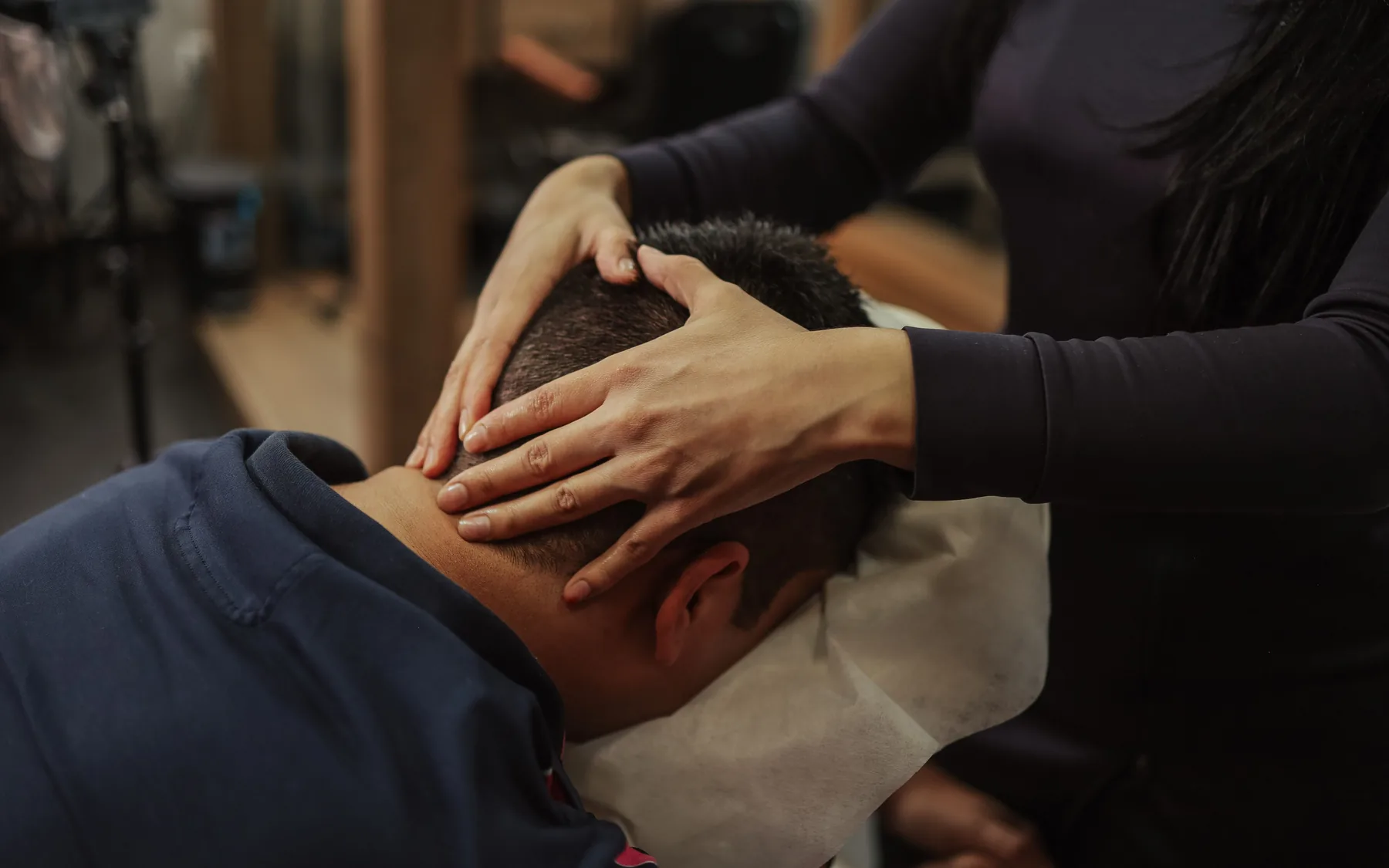
- 03Light contacts are made at specific points near the spine. Most people describe the pressure as similar to a fingertip resting on the skin.
- 04You will be asked to breathe in particular ways at particular moments.
- 05Follow-up sessions are short. Ten to twenty-five minutes is typical, and some are shorter than that.
- 06Some people feel a wave of movement through the body. Others feel very little the first few times. Both are normal.
Most people arrive expecting to be cracked. NetworkSpinal does not work that way. The contact is light enough that patients sometimes ask when the session is going to start.
Rather than moving a joint by force, the work uses precise, gentle contacts at particular points along the spine, combined with your own breath.
Where the contacts are made
The technique concentrates on two areas: the top of the neck and the base of the spine. Within the method these are called spinal gateways, and the choice of where to make contact on a given day depends on what the assessment and the practitioner’s hands find at the time.
The pressure is light. Not firm-but-gentle, which is how most hands-on therapy describes itself. Light in the sense that a fingertip resting on skin is light. There is no thrust, no joint cavitation, and nothing that makes a sound.
Light is not the same as passive, and this is the part the word undersells. The contacts are precise, held, and chosen. Where Dr. Todd puts his hands on a given day comes out of what he finds that day. People who have had both this and conventional adjusting usually say this takes more skill, not less.
What happens next is also not subtle. Many people feel movement travelling through the body, often starting somewhere other than where the hands are. Breathing changes on its own. Some people find it emotional. Others feel almost nothing for the first few visits and then one day do.
None of those is the correct response and none of them is a measure of whether it is working.
You stay fully clothed throughout, lying on a padded table.
Where it comes from
NetworkSpinal was developed by Donald Epstein, DC, who began teaching it in the 1980s. It was known for most of its history as Network Spinal Analysis, and you will still find it under that name in older writing and in some directories. The method was renamed to NetworkSpinal in the late 2010s.
Dr. Todd has practised it for most of his career, and it is the reason this practice looks different from most chiropractic offices in the region.
The assessment
The assessment that comes with NetworkSpinal care is called CORESCORE, and it combines three non-invasive scans into a single report.
Surface EMG places small sensors on the skin and records the electrical activity in the muscles running alongside the spine, including whether the left and right sides are producing similar amounts.
Thermal scanning is a contact thermometer run down the back. It compares skin temperature on the left and right side at the same height. There is no radiation and no imaging of any kind.
Heart rate variability records the small variations in time between one heartbeat and the next, over a few minutes, under consistent conditions.
What these are not
This is the part worth reading twice.
They are not diagnostic tests. They do not identify disease and they are not a substitute for the tests your physician would order. They are not imaging: there is no X-ray, no MRI, and no picture of your anatomy. If imaging is warranted, that is a referral.
A number moving is not proof of anything on its own. Readings shift for ordinary reasons, including the room, the time of day and what you did that morning. What they give you is a consistent set of measurements taken the same way each time, so a year from now there is something to compare against rather than two people trying to remember what March felt like.
They are also not required. If you would rather skip them, say so. It changes nothing about whether you can be seen here.
We go through the report together. Ask for a copy and you will get one.
Being straight with you about the evidence
NetworkSpinal is a widely taught technique with a clear lineage and a large body of practitioners. It is also a technique whose published literature is mostly case reports and practitioner surveys rather than controlled trials.
That is a real limitation and we would rather say it than let you find it out somewhere else. What we will tell you about is what happens in a session and what the measurements record. What we will not do is tell you what it will do for a particular condition, because the honest answer is that nobody can tell you that from the evidence that exists.
If you are dealing with something that needs a medical diagnosis, you need a physician, and we will say so rather than taking the appointment.
Even if the problem I go in for doesn’t get addressed immediately, I nevertheless always am grateful to be “trained” (entrainment?) or reminded how to breathe deeply into parts of my body I had disconnected from. Todd touch and mastery of his field leaves me feeling renewed and highly relaxed every time! In this crazy world, he helps me reconnect with my inner calm. Thank you Todd Stein!